

Compost
The gardener’s gold
Healthy, nutrient-rich fruit and vegetables can only grow if all the important elements are already present in the soil. The best way to achieve this is with humus. Every gardener can easily make this particularly fertile garden soil themselves …
A wonderful transformation
The most important element of humus management is having your own compost. What happens here is a true miracle of nature: plant residues from the garden and kitchen are converted by billions of microorganisms and then returned to your garden as particularly fertile soil. Compost is not only useful for vegetable beds, but also for shrubs, trees, hedges and fruit trees. It is simply raked lightly into the soil. If the compost is finely sieved, it can also be spread on the lawn with a rake.
You can find more on this topic in > Oscorna gardening knowledge
Faster to humus
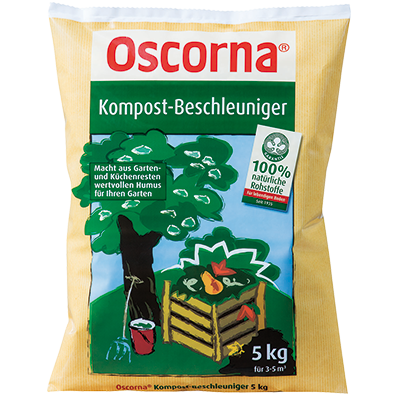
It usually takes about a year for garden and kitchen waste to turn into compost. Oscorna Compost Accelerator puts an end to long waiting times. When used correctly, you will have well-matured compost after just eight to 12 weeks. In addition to speeding up the process, you also benefit from enrichment of your humus – for example, with important trace elements.
Oscorna Compost Accelerator
- Reduces composting time to just a few weeks
- Enriches your compost soil with important trace elements
- Can be used all year round
How to apply the correct dosage
Application of Oscorna Compost Accelerator
| Application | Oscorna Compost Accelerator |
|---|---|
| Dosage: | Sprinkle at least 200 g/m² of Oscorna Compost Accelerator approximately every 20 cm. Then cover with a thin layer of garden soil |
| Main application period: | January to December |
| Package size: | 5 kg / 10 kg |
Composting with Oscorna – how it works:
If you follow a few rules, you will soon be successfully producing your own humus.
Compost bin and location
- Whether you use a commercially available composter or build your own, make sure that the model is permeable to air.
- Choose a semi-shaded spot so that the compost heap does not dry out too easily.
- Place the composter directly on the garden soil. This allows microorganisms and earthworms to move in quickly and start working.
- The ideal composting spot is in partial shade, 120 cm wide, 150-200 cm long and 120 cm high.
The correct structure
- Layer the compost material loosely and mix it so that as much oxygen as possible can circulate. Do not build the pile too high.
- The first layer should consist of all rotable and raw garden and kitchen waste, shredded wood cuttings, leaves, grass, etc., up to a height of approximately 20 centimetres.
- Sprinkle a generous amount of Oscorna compost accelerator over the second layer: we recommend at least 200 g/m².
- The third layer is a thin layer of garden soil. This serves as a further ferment, improves the smell and appearance.
- Repeat the sequence of layers until the heap or silo is complete.
Promote initial heating
Keep the compost moist, but not wet, so that the necessary initial heating can take place.
What can be put on the compost heap?
Well suited:
Dried grass clippings, shredded tree, shrub and hedge trimmings, other garden waste, kitchen waste such as raw vegetable and fruit scraps, onion skins, crushed eggshells, coffee grounds.
Unsuitable:
Cooked and meat-containing kitchen scraps.