

Fruit and vegetables
Tastes like more
Try tomatoes, carrots, lettuce, cauliflower or radishes from a naturally fertilised garden.
When the focus is on quality and health benefits rather than high yields, you can taste the difference.
Rich supply of essential nutrients
“Only put in the soil what earthworms can digest.”
With Oscorna, you fertilise your plants according to the principle of the natural cycle. In untouched nature, billions of soil organisms ensure that there is always enough food available for plants. This happens through the continuous conversion of dead plant and animal material into nutrient-rich humus. Oscorna fertilisers work in exactly the same way. They contain a variety of high-quality organic raw materials that nourish soil life. In addition to the main nutrients, the plants thus receive a rich supply of essential trace elements. The plant gradually absorbs these through the soil. Its food is therefore available to it evenly, leading to healthy and vigorous growth.
You can find more on this topic in > Oscorna gardening knowledge
It’s all about the mix
Whether it’s Oscorna-Animalin garden fertiliser, berries or any other Oscorna fertiliser, we always mix finely ground raw materials with coarser components. This ensures that plants are evenly nourished from the beginning to the end of the growing season. This makes using Oscorna fertilisers simple and straightforward.
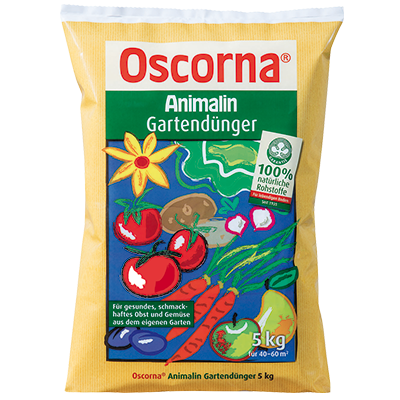
Oscorna-Animalin Garden Fertiliser
Organic NPK fertiliser 7-4-0.5
Proven for decades: the natural fertiliser for everything that grows in the garden- Contains high-quality natural nutrients and trace elements
- Easy to use thanks to its immediate and long-term effect
- Revitalises the soil
- Promotes the formation of humus
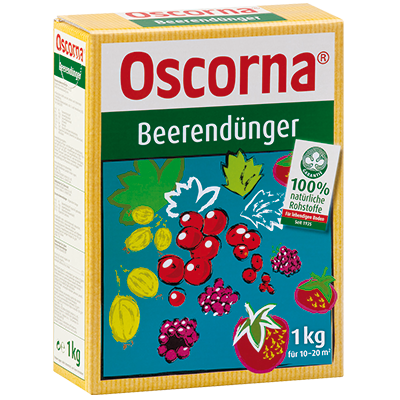
Oscorna Berry Fertiliser
Organic NPK fertiliser 6-6-0.5
Specially formulated for healthy growth, abundant harvests and wonderful flavour in all types of berries- Main nutrients in a favourable ratio for all berry crops
- Complete plant nutrition with many trace elements
- Works both directly and long-term
- Good for soil vitality and humus formation
Organic fertilisation for fruit and vegetables – how it works
The Oscorna principle applies particularly to fruit and vegetable gardens: first the soil, then the plant nutrition. The most important basis for a good harvest is fertile soil combined with pure organic fertiliser.
Improving the soil in the kitchen garden
Loosen the soil before sowing or planting with a digging fork and work 100-200 g/m² Oscorna Soil Activator > Topic: Soil into the surface. This creates loose, crumbly soil and significantly increases soil fertility.
What else you can do
The aim of a natural garden is to create a healthy habitat for people, plants and animals. Other cornerstones include crop rotation, mixed cultivation and composting > Oscorna gardening tips It is also important to choose suitable, robust plants. Seek advice from experts on which varieties are suitable for your garden!
The little snack garden on the terrace and balcony
For impressive harvests in even the smallest of spaces, we recommend using a good quality flower and plant soil. For every 10 litres of soil, add 50 g of Oscorna Animalin garden fertiliser and 100 g of Oscorna Soil Activator. This means that these quantities of Oscorna products are mixed evenly with the soil. Use high-quality seeds and seedlings. Water sufficiently and keep the soil moist.
Fertilise once, double the effect
The main fertilisation with Oscorna-Animalin garden fertiliser takes place in spring. Heavy and medium feeders are fertilised again during the growing season. Fertilise perennial berries after harvesting and once in spring. Spread the fertiliser evenly and hoe it into the surface so that it comes into good contact with the soil, but is not buried. Subsequent watering or a light spring rain will accelerate the immediate effect.
It is particularly important that all Oscorna fertilisers feed the microorganisms in the soil. They therefore support the soil improvement that you have initiated with the Oscorna Soil Activator. In addition, natural fertilisers generally offer an immediate and long-term effect throughout the entire growing season.
For your shopping list
| Use in flower beds | Oscorna-Animalin garden fertiliser |
|---|---|
| Main fertilisation: | Approximately 100 g/m² in spring (heavy feeders need 120 g/m²; light feeders need only 80 g/m²) |
| Re-fertilisation: | Heavy and medium feeders with half the application rate during the growing season |
| Main period of use: | February to November |
| Package size and average coverage: | 1 kg for 10 m² 2.5 kg for 25 m² 5 kg for 50 m² 10.5 kg for 105 m² 20 kg for 200 m² |
Spread an additional 100 g/m² of Oscorna Soil Activator 1-2 times a year.
| Application | Oscorna Berry Fertiliser |
|---|---|
| Main fertilisation: | New plants: Before planting in summer, spread 100 g of Oscorna Berry Fertiliser and 200 g of Oscorna Soil Activator per square metre and work lightly into the soil Perennial crops: After harvesting, spread 100 g Oscorna Berry Fertiliser and 100 g Oscorna Soil Activator per m² evenly and work lightly into the soil |
| Re-fertilisation: | In spring: After loosening the beds for the first time, spread 50 g Oscorna Berry Fertiliser per m² |
| Main application period: | March to April; August to October |
| Package size and coverage: | 1 kg for 10 m² 2.5 kg for 25 m² |
It couldn’t be easier
Spread 1-2 times a year per square metre 2 handfuls of Oscorna Soil Activator (approx. 100 g)
Sprinkle two handfuls of Oscorna Animalin Garden Fertiliser* (approx. 100 g) per square metre and fertilise with half the amount during the growing season, depending on the crop.
Organic raised bed fertilisation
A newly created raised bed that has been layered according to our recommendations contains sufficient nutrients, meaning that no additional fertilisation is required in the first year. Details on raised beds can be found here > Creating a raised bed – how to proceed
From the second year onwards, we recommend fertilising with Oscorna-Animalin garden fertiliser and improving the soil with Oscorna-BodenAktivator.
For your shopping list
| Use in raised beds | Oscorna-Animalin garden fertiliser |
|---|---|
| Main fertilisation: | Heavy feeders 120 g/m²; medium feeders 100 g/m² |
| Re-fertilisation: | Heavy and medium feeders with half the application rate during the growing season |
| Main period of use: | February to November |
| Package size and coverage: | 1 kg for approx. 8 – 10 m² 2.5 kg for approx. 20 – 25 m² 5 kg for approx. 40 – 50 m² 10.5 kg for approx. 90 – 105 m² 20 kg for approx. 170 – 200 m² |
| Application | Oscorna Soil Activator |
|---|---|
| Once a year in spring*: | 200 g/m² |
| Package size and coverage: | 3 kg for 15 m² 5 kg for 25 m² 10 kg for 50 m² 25 kg for 125 m² |
*If you do not compensate for annual settling processes in raised beds with compost, but use unfertilised soil, we recommend a second application of Oscorna Soil Activator at a rate of 200 g/m² during the growing season.
We recommend growing low-nutrient plants only after the raised bed has been in place for three years. No additional fertilisation is recommended here. Soil improvement with Oscorna Soil Activator (200 g/m²) covers the nutrient requirements for low-nutrient plants such as herbs, beans or peas in raised beds.
Heavy feeders and ascetics
The requirements of individual vegetable varieties vary greatly. Some need “concentrated feed”, while others are content with modest meals.
Vegetable varieties are therefore divided into three groups, for example:
| Heavy feeders | Medium feeders | Light feeders |
|---|---|---|
| Cabbage varieties such as red cabbage, white cabbage savoy cabbage cauliflower Brussels sprouts Chinese cabbage Cucumbers Potatoes Leeks Celery Pumpkin Courgettes Tomatoes Rhubarb |
Onions Garlic Carrots Beetroot Fennel Lettuce varieties Spinach Salsify Radishes Kohlrabi Peppers Melons |
Beans (legumes) Peas (legumes) Herbs |
Tips for the kitchen garden and snack garden
Deep-rooted root vegetables
If you want to grow deep-rooted root vegetables (such as radishes, black salsify and carrots) in spring, we recommend applying Oscorna-Animalin garden fertiliser to the beds in autumn.
berry bushes
- Blackberries and raspberries require humus-rich soil and a sunny location. Blackberries planted along the garden fence form a dense hedge and provide a harvest rich in vitamin A.
- Water raspberries carefully during dry periods, as they are shallow-rooted plants. For once-bearing raspberry varieties, cut the harvested canes close to the ground in September, as only the new shoots will bear fruit the following year.
- Currants and gooseberries are very long-lived (10-15 years), so their location must be carefully considered. A light, airy and sunny spot is ideal for the plants to develop well and for the berries to form their health-promoting substances. A single shrub requires a base area of one square metre.
- Red currants need a sunny location, but are otherwise undemanding. Each bush should only have 8–10 main branches. Every year, after harvesting or after winter, remove 2–3 of the main shoots that are over 3–4 years old (cut them off close to the ground).