


The rose
On Her Majesty’s orders
Whether in a flower bed, along a house wall or in a hedge, the rose is considered the queen of the garden. Its lush blossoms are particularly dear to many gardeners. Because it consumes a lot of energy, it is extremely grateful for additional nutrients.
Proper rose care
for beauty, fragrance and resilience
How much enjoyment you will get from your rose begins with the selection of the plant, the location and the planting > Oscorna gardening knowledge . Choose a sunny but airy spot to avoid heat build-up.
The right > plant partners not only create a charming display, but can also keep pests away. Lavender, for example, protects roses from aphids. It is best to plant lavender at the edge of the rose bed, as both plants have different water and nutrient requirements.
Because roses often remain in the same location for many years, regular soil improvement promotes their health and flowering. Rose experts therefore recommend applying a generous 200 g/m² of Oscorna Soil Activator in early spring – in addition to fertiliser.
To ensure that your roses are resistant to aphids, fungi and other diseases, it is important to provide them with sufficient nutrients.
Details on planting roses can be found in > Oscorna gardening tips
How to get your roses to bloom
After purchasing bare-root rose bushes, it is important to water the plant well and trim the roots. Mix the potting soil or excavated soil generously with two to four handfuls of Oscorna Soil Activator. The grafting point should be at least 5 cm below the soil surface.
Important: Bare-root plants should only be planted in early spring and late autumn, while container plants can be planted all year round.
Energy boost for flowering
Water thoroughly after planting and sprinkle Oscorna rose fertiliser on the surface. This will provide the rose with everything it needs for the first few months. As a rule, fertilise your roses once in early spring and once after the first flowering, i.e. around June, with 120 g//m² in each case.
Oscorna rose fertiliser
Organic NPK fertiliser 6-9-0.5
- Balanced nutrient combination for all types of roses
- Supports hybrid tea roses, wild roses, shrub roses and climbing roses in their natural growth and flowering
- Prevents deficiency symptoms and thus improves resistance to diseases and pests
- Combination with Oscorna Soil Activator recommended as a prophylactic measure against soil depletion
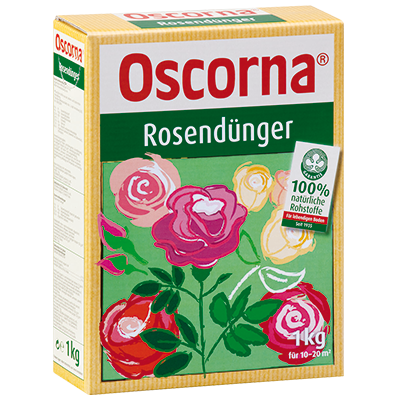
For your shopping list
Application of Oscorna rose fertiliser
| Application | Oscorna rose fertiliser |
|---|---|
| Main fertilisation: | In early spring or when planting new plants, spread 120 g/m² evenly |
| Re-fertilisation: | After the first flowering: 120 g/m² |
| Soil improvement: | When planting and every spring, 200 g/m² Oscorna Soil Activator |
| Main application period: | March and April; June and July |
| Main fertilisation Oscorna rose fertiliser Package size and coverage: |
1 kg for approx. 8 m² 2.5 kg for approx. 20 m² 10.5 kg for approx. 90 m² 20 kg for approx. 170 m² |
| Soil improvement Oscorna Soil Activator Package size and coverage: | 3 kg for approx. 15 m² 5 kg for approx. 25 m² 10 kg for approx. 50 m² 25 kg for approx. 125 m² |
It couldn’t be easier
In spring, scatter 4 handfuls of Oscorna Soil Activator (approx. 200 g) AND 2-3 handfuls of Oscorna Rose Fertiliser (approx. 120 g) per square metre
In summer, sprinkle 2-3 handfuls of Oscorna Rose Fertiliser (approx. 120 g) per square metre.
Planting roses correctly
Roses are deep-rooted plants and can reach soil layers up to 80 cm deep. When planting new roses, make sure that the topsoil is not poured onto compacted ground.
Preparing soil for roses
To ensure that your roses grow as you wish, please pay close attention to soil preparation. Mix two handfuls of Oscorna Soil Activator into the high-quality potting soil for each planting hole.
It is important to remove troublesome root weeds thoroughly before planting, as they are difficult to control later on. When planting bare-root roses, cut back the green shoots to about 15–20 cm beforehand. Also shorten the taproot and broken roots. Always take care not to damage the fine fibrous roots, as only these can absorb water and nutrients. The more fibrous roots a rose has, the faster it will grow and the more vigorously it will bloom in summer.
Earthing up protects rose shoots
The final step is to earth up the roses. Earth up the roses so that only the tips of the rose shoots are visible. Do this every season, even if you are planting in spring. Earthing up protects the young seedlings from wind, cold and sun. The shoots remain enclosed in their mantle of earth and protected from moisture until they can supply themselves with water and nutrients via newly anchored roots.
This ensures that the rose is well cared for during the first few months. Regular natural fertilisation and correct pruning of your roses will then ensure continued healthy growth.
Water bath for spring roses
Before planting, especially in spring, immerse the bare-root roses in a water bath for at least 10 to 12 hours, ensuring that all shoots and roots are submerged. The water bath before planting ensures that the shoot cells can replenish their water reserves. This gives the rose a good start in its new location.
Planting hole and planting depth
The planting hole should measure approximately 40 cm in height, width and depth. Loosen the bottom of the planting hole thoroughly with a digging fork so that the roots still hang freely in the air at the correct planting depth. Now fill the hole around the rose roots with planting soil mixed with Oscorna Soil Activator, then sprinkle a handful of Oscorna Rose Fertiliser on top and press down lightly. Water thoroughly to ensure that the roots and soil bond together and to close any underground cavities.
The right time to plant roses
Apart from cold spells and ground frost, garden roses can be planted all year round. However, there is a difference between container roses and bare-root roses.
autumn planting
The ideal planting time for bare-root roses is from mid-October to mid-November. The garden soil still retains some of the summer heat, which is good for root formation. Bare-root roses should not be planted before the first of October, as they are often harvested too early and the shoots, which are still green, are insufficiently mature and therefore not very winter-hardy.
spring planting
In early spring, i.e. until the end of April, packaged and bare-root roses can be planted without hesitation. The further the product has sprouted, the more difficulties with growth can be expected.
summer planting
Thanks to the wide range of container plants available, summer has become the main planting season for roses. It is important to water container plants continuously after planting. From the second year onwards, the roses will have established themselves to such an extent that they can supply themselves with water.
The most important rose tips
- Always choose a sunny, bright, well-ventilated location for roses.
- Pile a 4–5 cm layer of mature compost around your rose bushes.
- During hot summer weeks, only water the root area. Water sprayed over the plants promotes fungal diseases.
- To encourage abundant budding, regularly remove all dead flowers.
- Correct pruning is an important factor for success for rose lovers. This is usually done in early spring. Because you need to use your secateurs differently depending on the type of rose, it is best to consult an expert.