

Trees and shrubs
Regular visitors to your garden
Trees and shrubs determine the structure and appearance of a garden like no other type of plant. Not only are they particularly durable and resilient, but many of them also grow to a considerable size over the years.
Shrubs in a natural garden
Shrubs can fulfil a variety of functions in the garden: they provide shade, serve as decorative elements in ornamental gardens, and protect against wind or prying eyes when used as hedges. Evergreens such as rhododendrons, privet, cherry laurel and conifers bring the garden to life in winter.
Native trees and shrubs attract beneficial insects
In natural gardens, trees and shrubs also fulfil important ecological functions. They provide shelter and habitat for a range of bird, animal and insect species. Native trees and shrubs such as rock pear, cornelian cherry and elderberry are also an important source of food for winged garden inhabitants, from bees to great spotted woodpeckers. A natural hedge made up of various shrubs makes a special contribution to the ecosystem and is sure to attract a range of beneficial insects.
You can find more information on beneficial insects in > Oscorna gardening tips
Our products for trees and shrubs
Providing trees and shrubs with the right nutrients is particularly important when planting a new garden. This is because they help newly planted shrubs, trees and hedges to quickly develop an extensive root system and grow vigorously and densely > New planting. Oscorna offers a range of different, purely organic special fertilisers for deciduous and coniferous trees and shrubs. They provide young plants with exactly the combination of nutrients and trace elements they need for their development. At the same time, they are suitable for regular long-term supply and for the regeneration of older stocks.
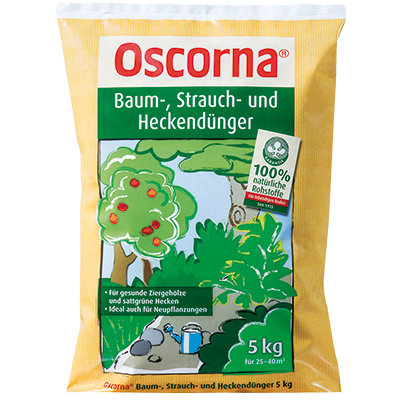
Oscorna tree, shrub and hedge fertiliser
Organic NPK fertiliser 6-4-0.5
- Complete plant nutrition for all deciduous and coniferous trees and shrubs
- Immediate and long-lasting effect in one
- Rich in valuable trace elements
- 100% natural fertiliser for rich soil life
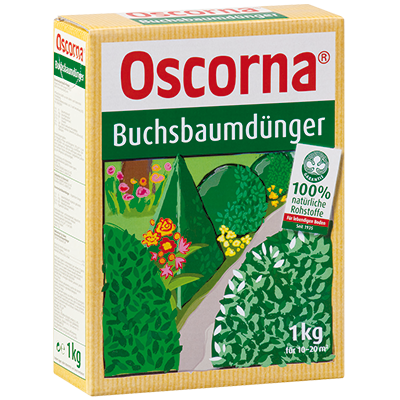
Oscorna boxwood fertiliser
Organic NPK fertiliser 6-4-0.5
- Organic instant and slow-release fertiliser specially formulated for boxwood
- For strong root growth and dense foliage
- Takes effect immediately after application and continues to work over a longer period of time
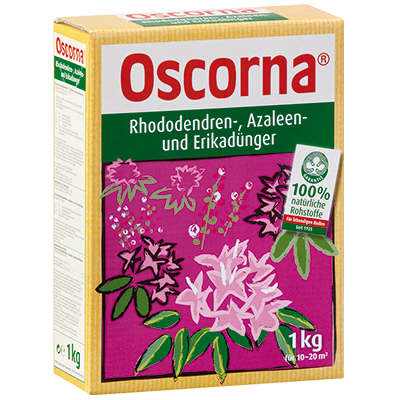
Oscorna rhododendron, azalea and heather fertiliser
Organic NPK fertiliser 6-3-0.5
• Special fertiliser for abundant bud formation, lush flowering and fresh, green foliage
• Balanced composition of all important nutrients
• Contains a variety of natural trace elements
• Immediate help with nitrogen and iron deficiency
• Long-lasting effect
How to apply the correct dosage
| Application | Oscorna tree, shrub and hedge fertiliser |
|---|---|
| Main fertilisation: | Fertilise once a year – preferably in late autumn – by spreading around the base of the plant, working it in lightly and then watering. Application rate for existing plants: 120 g/m² (= 1 yoghurt pot of 150 g) for shrubs and hedges 100-150 g/m² for trees with a trunk diameter of up to 20 cm 150-200 g/m² for trees with a trunk diameter of 20 cm or more |
| Main application period: | March to June; October and November |
| Package size: | 5 kg, 10.5 kg |
| Application | Oscorna boxwood fertiliser |
|---|---|
| Main fertilisation: | Early spring. 100 g/m² for box trees 100 g per running metre of box hedge |
| Re-fertilisation: | Re-fertilise until the end of June 50 g/m² for box trees or 50 g per running metre of box hedge |
| Main period of use: | March, April and June |
| Package size: | 1 kg and 2.5 kg |
| Application | Oscorna rhododendron, azalea and heather fertiliser |
|---|---|
| Main fertilisation: | In early spring or when planting new plants, spread 100 g/m² evenly. |
| Follow-up fertilisation: | In mid-June, spread 50 g per m² evenly. |
| Main application period: | March, April and June |
| Package size: | 1 kg, 2.5 kg and 20 kg |
Tips for evergreens, deciduous trees and conifers
Beautiful hedges and shrubs
When fertilising, it is advisable to spread the same amount of > Oscorna Soil Activator in addition to Oscorna Tree, Shrub and Hedge Fertiliser in order to maintain healthy plant growth.
- Only cut back hedges and shrubs in the late afternoon. At this time of day, the sap retreats back into the trunk, only to rise again the next day into the branches, twigs and leaves.
- Watch out for bird nests and observe the birds’ breeding seasons. In autumn, leave the withered leaves under the hedge as ground cover. Not only does this enrich the soil with humus, it also provides a warm winter shelter for animals.
Brown needles? That's good for conifer hedges
- Have you noticed that the needles on spruce, fir and conifer trees are turning brown again? The causes are: soil fatigue, magnesium deficiency, nutrient blockages, lack of trace elements and an unfavourable pH value.
- To restore the plants to health, sprinkle 200 g/m² of Oscorna Soil Activator in spring and autumn and ensure sufficient watering.
- Once the plants have recovered, you can reduce the application rate to 150 g/m² of Oscorna Soil Activator once a year.
Fertilising rhododendrons and azaleas correctly
- Rhododendrons thrive best in slightly acidic soil and are extremely sensitive to lime. The pH value should be between 4.5 and 5.5.
- Mid-September to the end of May – provided there is no frost and the ground is open – is the best time to plant rhododendrons. Always make sure that the root ball is sufficiently moist when planting.
- Rhododendrons love partial shade and need plenty of water in summer.
- Immediately after flowering, it is advisable to carefully remove the flower clusters. This prevents unnecessary seed formation and promotes new flower buds and healthy growth of the rhododendrons.
- When breaking off the clusters, take care not to damage the buds underneath.